

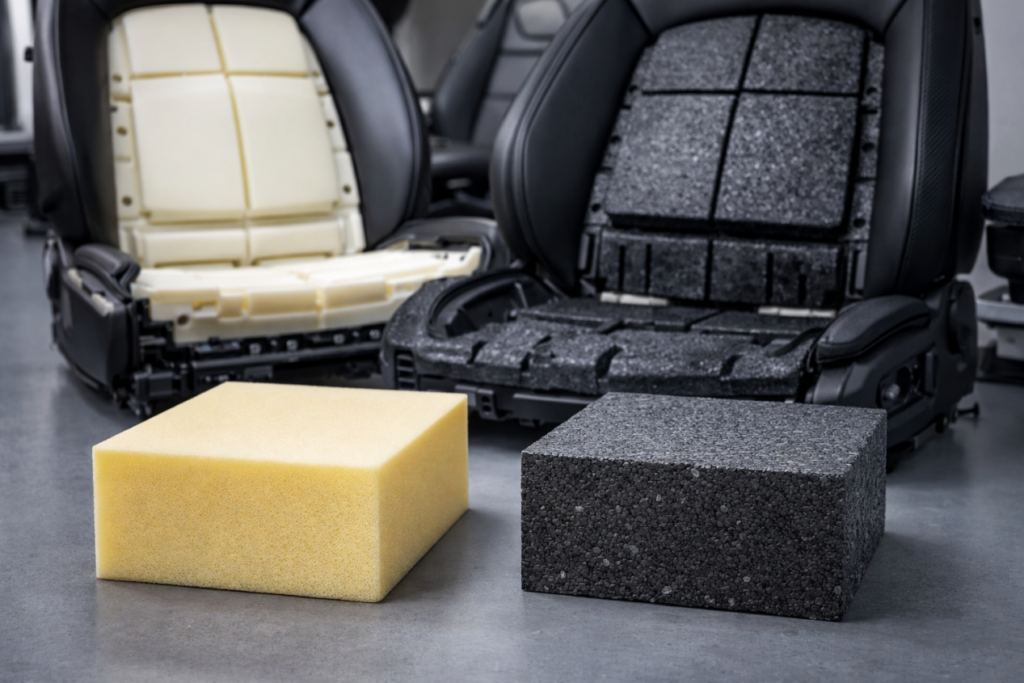
Automotive seating is evolving as manufacturers balance comfort, safety, lightweighting, and sustainability. PU foam and EPP are two key materials, each serving distinct engineering roles in next-generation seat design.
Overview of PU Foam in Automotive Seating
What Is PU Foam?
Polyurethane (PU) foam is formed by reacting polyols and isocyanates. In automotive seating, high-resilience PU foam dominates cushioning due to its adjustable density, hardness, and rebound. As a thermoset material, it offers strong dimensional stability and long-term durability under repeated use.
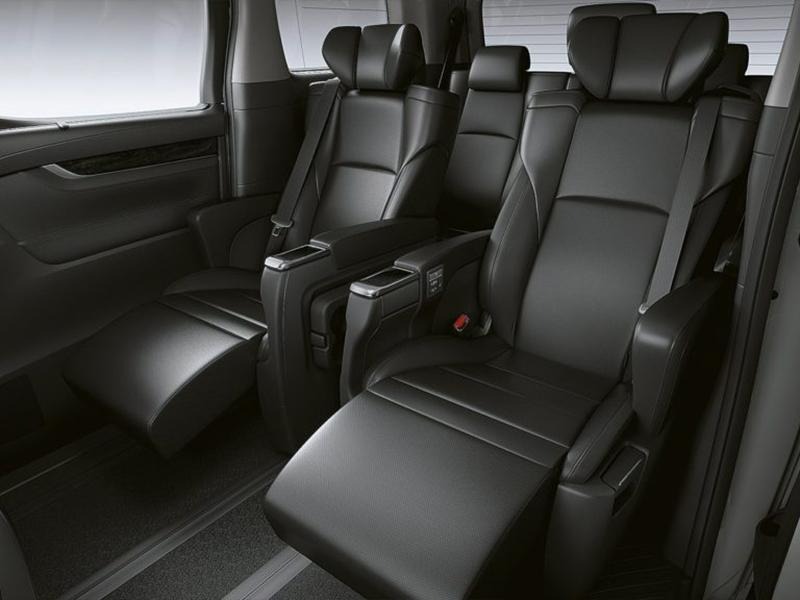
Typical Applications in Automotive Seats
PU foam is widely used in:
- Seat cushions
- Backrests
- Armrests
- Headrests
- Lumbar support zones
Because of its tunable comfort properties, it remains the primary material for direct body-contact areas.
Key Advantages of PU Foam
- Superior Comfort and Pressure Distribution
PU foam offers excellent load distribution, reducing pressure points during long drives. - Adjustable Density and Hardness
Density can range typically from 35–65 kg/m³, allowing optimization for comfort versus structural support. - Fatigue Resistance
High-resilience foams maintain performance over hundreds of thousands of compression cycles. - Mature Manufacturing Ecosystem
PU seat foaming is highly industrialized, with established mold-based injection processes.
Modern seat manufacturers rely on precision mold-based injection systems for consistent density control. Yongjia Polyurethane supports this with integrated PU foaming solutions that combine materials, molds, and injection equipment for efficient seat production.
Limitations of PU Foam
- Heavier than ultra-light thermoplastics in some structural applications
- Limited recyclability compared to thermoplastics
- Requires precise mixing and mold systems for consistent quality
Overview of EPP in Automotive Seating
What Is EPP?
Expanded polypropylene (EPP) is a lightweight, closed-cell thermoplastic foam made by expanding polypropylene beads and molding them under heat and pressure. Unlike PU foam, EPP is thermoplastic and recyclable.
Its structure consists of fused beads that create a durable yet lightweight form.
Typical Applications in Automotive Seats
EPP is commonly used for:
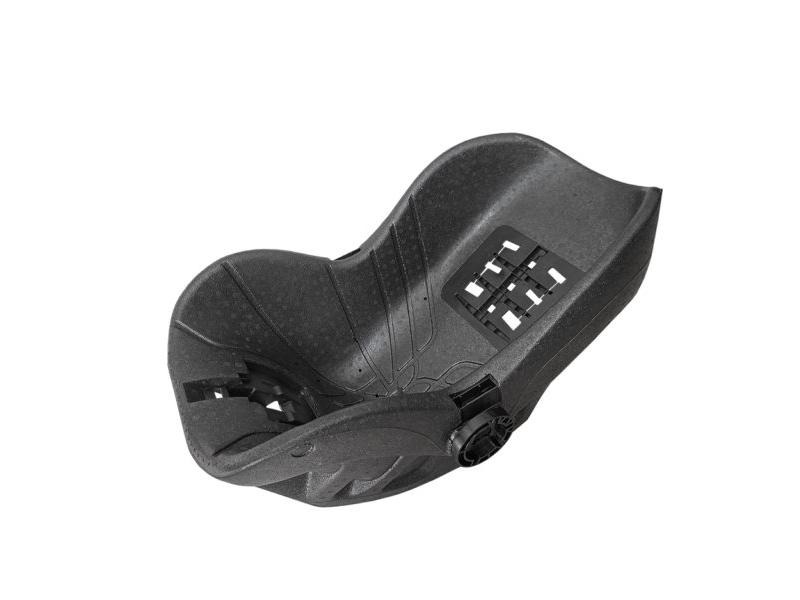
- Headrest cores
- Structural reinforcement inserts
- Seat base cores
- Impact energy absorption zones
It is less commonly used as the primary comfort layer but plays a growing role in structural lightweighting.
Key Advantages of EPP
- Exceptional Lightweight Properties
Density ranges typically between 20–60 kg/m³ - Impact Resistance
EPP has excellent energy absorption, making it suitable for crash zones. - Recyclability
As a thermoplastic, it can be remelted and reused. - Dimensional Stability
Maintains shape even under fluctuating temperatures.
Limitations of EPP
- Lower softness and contouring capability compared to PU
- Limited ergonomic adaptability
- Higher initial tooling investment for steam chest molding
Material Property Comparison
Below is a direct performance comparison across key engineering criteria:
Core Material Property Comparison
| Property | PU Foam | EPP |
|---|---|---|
| Material Type | Thermoset polymer | Thermoplastic polymer |
| Density Range | 35–65 kg/m³ | 20–60 kg/m³ |
| Comfort Level | Excellent | Moderate |
| Impact Resistance | Good | Excellent |
| Fatigue Durability | High | Medium–High |
| Recyclability | Limited | High |
| Thermal Stability | Stable | Highly stable |
| Design Flexibility | Very High | Moderate |
PU foam clearly dominates in comfort and ergonomic performance, while EPP excels in lightweight and recyclability.
Performance Comparison by Key Criteria
Comfort & Ergonomics
Comfort remains the primary purchase driver for vehicle seating. PU foam offers superior:
- Progressive compression
- Pressure distribution
- Vibration damping
- Custom hardness zoning
EPP, while structurally strong, does not offer the same softness and adaptability. It is more rigid and functions better as a support core than a direct comfort layer.
For premium and long-distance vehicles, PU foam remains the preferred material for primary seating surfaces.
Weight Reduction Potential
Weight reduction is a primary focus in EV and fuel-efficient vehicle design.
EPP offers clear advantages in pure density reduction. Structural EPP components can reduce seat weight by 10–20% in certain designs.
However, advances in low-density HR polyurethane formulations have significantly narrowed the gap. Modern PU systems can achieve density reductions while maintaining comfort performance.
The most effective approach often combines both materials strategically.
Safety & Energy Absorption
Safety standards require seats to absorb energy during impact events.
EPP demonstrates excellent energy absorption and rebound capability, making it suitable for headrest cores and side-impact zones.
PU foam offers progressive compression, which provides comfort-driven energy absorption rather than structural shock resistance.
In crash-focused applications, EPP has an advantage.
Durability & Long-Term Performance
PU foam excels in:
- Compression set resistance
- Long-term fatigue cycles
- Comfort retention over time
EPP maintains shape stability but does not provide the same long-term ergonomic comfort under repeated compression.
For daily-use seating applications with frequent load cycles, PU foam remains superior.
Sustainability & Environmental Impact
Environmental considerations increasingly influence material selection.
EPP’s recyclability provides a clear advantage in circular economy strategies.
PU foam sustainability improvements focus on:
- Bio-based polyols
- Reduced VOC emissions
- Optimized material efficiency
Both materials are evolving toward greener formulations.
Manufacturing & Processing Differences
The manufacturing process strongly influences material performance, cost, and scalability.
PU Foam Production Process
PU seat cushions are typically produced using:
- High-pressure injection machines
- Closed aluminum molds
- Automated mixing systems
The process involves chemical reaction foaming inside precision molds. Density control depends on accurate mixing ratios and mold temperature management.
Typical cycle time: 3–6 minutes per part.
Advantages:
- Precise hardness zoning
- Complex contour molding
- Fast cycle times
- Strong automation compatibility
EPP Production Process
EPP is produced through:
- Bead pre-expansion
- Steam chest molding
- Pressure fusion
The process requires steam-resistant molds and high-temperature cycles.
Typical cycle time: Moderate to longer than PU in certain applications.
Advantages:
- Excellent structural consistency
- Strong impact resistance
- Lightweight structural components
Manufacturing Comparison
| Factor | PU Foaming System | EPP Molding System |
|---|---|---|
| Equipment Cost | Moderate | Higher |
| Tooling Requirement | Precision aluminum molds | Steam chest molds |
| Cycle Time | Fast | Moderate |
| Automation Compatibility | High | Moderate |
| Material Waste | Low (controlled injection) | Low–Moderate |
| Process Complexity | Chemical mixing control | Steam pressure control |
PU systems are typically more flexible for multi-model production environments.
Cost Considerations
Material selection is not based solely on performance.
Cost factors include:
- Raw material pricing
- Equipment investment
- Mold tooling
- Energy consumption
- Labor requirements
- Lifecycle durability
EPP tooling tends to require higher initial investment due to steam chest requirements. PU mold systems also demand precision but are widely standardized.
From an ROI perspective, PU foam remains cost-effective for high-volume seat production.
EV Market Influence
Electric vehicles significantly influence seat material decisions.
Battery packs increase overall vehicle weight, pushing engineers to reduce interior mass.
EPP supports lightweight structural components in EV seat platforms. However, EV buyers also demand premium comfort, reinforcing PU’s importance.
Many EV seat systems now integrate:
- PU foam cushioning
- EPP structural inserts
- Lightweight metal frames
Hybrid material strategies are becoming the industry standard.
When to Choose PU Foam
PU foam is preferable when:
- Comfort is the primary objective
- Long-term fatigue durability is critical
- Complex ergonomic shapes are required
- High-volume production efficiency is necessary
It remains the core cushioning solution in most passenger vehicles.
When to Choose EPP
EPP is suitable when:
- Structural lightweighting is the priority
- Impact absorption zones are required
- Sustainability goals demand recyclability
- Modular seat structures are implemented
It performs best as a structural enhancement rather than a standalone comfort material.
Hybrid Solutions: The Future of Automotive Seating
The industry increasingly adopts multi-material strategies.
Hybrid Seat Architecture Example
| Seat Component | Recommended Material |
|---|---|
| Cushion Comfort Layer | PU HR Foam |
| Structural Core | EPP |
| Frame | High-Strength Steel or Aluminum |
| Reinforcement Inserts | EPP or Composite |
This approach balances:
- Comfort
- Weight reduction
- Safety
- Sustainability
Hybrid design enables engineers to optimize each zone of the seat for specific functional requirements.
Industry Outlook
From 2025 onward, automotive seating materials will continue evolving toward:
- Ultra-low-density PU structural foam
- Recyclable thermoplastic foams
- Smart seating systems with embedded sensors
- Integrated lightweight seat modules
Rather than replacing PU foam, EPP is complementing it in a more sophisticated seat architecture.
Manufacturers capable of integrating material science with mold engineering and injection technology—such as solution providers like Yongjia Polyurethane—are better positioned to support evolving seat architectures efficiently and reliably.
PU foam and EPP each excel in different areas—PU in comfort and durability, EPP in lightweight strength and recyclability. The best solution is integrating both strategically. As EV growth and sustainability demands rise, balanced, multi-material seat engineering will define the future of automotive interiors.
